Monday, December 5, 2011

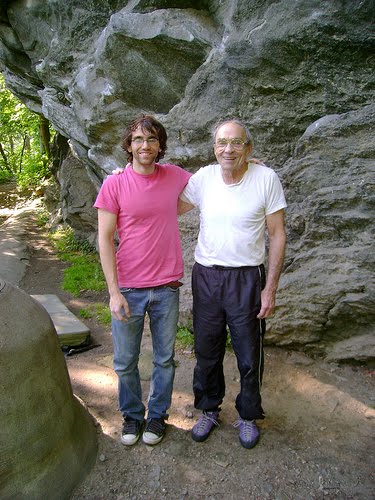
My "old" professor, Michael Cohen, from grad school


I owe a lot to Michael Cohen for teaching me physics. I never had a class from him; but, we used to solve problems together in his office. It is during those regular meetings at his blackboard that I evolved into a physicist. Memories of seeing him in action still bring chills down my spine. (Mike, in the white T-Shirt, is seen at his favorite climbing rock in Philadelphia with a younger climber back in 2008.)

At Penn, we had a problem-solving seminar run by Cohen that helped prepare us for the PhD qualifying exam. The first time I ever spoke to him was when I entered Mike's office to ask him a question. Before answering, he required me to solve a perturbation theory problem on the blackboard. His impish smile as he handed me the chalk will forever be imprinted in my brain. I suffered through the problem as he derided me for my lack of understanding. Though I had taken and passed all the classes, my poor mastery of the material was exposed.

The source of my problem was that perturbation theory did not hold in the regular way in this particular case. There would not have been a problem had I understood the concept. With a simple re-derivation of perturbation theory, the problem became trivial. To maintain his image as a hard-ass (he was feared by the graduate students), Cohen commented that my difficulties originated in the fact that I was an idiot. I was undeterred by his comments and continued to visit with him to learn about the wonderful mysteries of physics. I soon found that beneath the caustic exterior was lots of heart.

As I was walking by his office a year later, I saw a new graduate student literally sweating at the blackboard. I poked my head through the door and saw the infamous perturbation theory problem. Michael Cohen leaned forward from his desk with a somber expression and pointed at me stating "though Kuzyk here is an idiot, he can solve this problem." I was given the chalk and the three of us solved all sorts of problems for the rest of the afternoon.

I look back at those times with great fondness. More than thirty years have passed since first contact with Cohen, and I still rely on some of the intuition that I developed as a result of our relationship. A couple weeks back, I had a dream that Mike had been on our campus for months, and failed to stop by my office for a visit. So, I sent him an email to see how he was doing. I learned from his reply that he is now in his eighties and still rock climbing. For a story about Mike and his passion for rock climbing, check out http://chetroy.com/wordpress/?p=385.

Part of me misses those grad school days when time was filled with intense learning. All of you students out there should appreciate these days and spare no efforts to learn as much as possible. Not only is learning fun, but it shapes you into who you are. Never stop learning!

Friday, November 25, 2011

I am thankful for the First Amendment

We spent Thanksgiving with friends. As part of the traditional ritual, we were asked to make a list of four things for which we were thankful. My first two items, family and friends, were universal amongst the members of our group. Additional reflection made me realize that I was thankful for the U.S. constitution, and in particular, for the first amendment, which states,

"Congress shall make no law respecting an establishment of religion, or prohibiting the free exercise thereof; or abridging the freedom of speech, or of the press; or the right of the people peaceably to assemble, and to petition the Government for a redress of grievances."

These marvelous words should be read by all who are not outraged by current events.

The first ten amendments, or the Bill of Rights, are the handiwork of James Madison. There is much misinformation about the original intent of the framers of the US Constitution, which can be clarified by reading the original articles and letters written by the founding fathers. On the topic of separation of church and state, Madison clearly believed that government should stay out of religion, period.

In Annals of Congress (Annals of Congress, Sat Aug 15th, 1789 pages 730 - 731), he summarized his position as follows:

Congress should not establish a religion and enforce the legal observation of it by law, nor compel men to worship God in any manner contrary to their conscience, or that one sect might obtain a pre-eminence, or two combined together, and establish a religion to which they would compel others to conform.

In a letter to Robert Walsh on March 2, 1819, he expresses his view that a wall between government and religion leads to increased morality:

The civil Government, though bereft of everything like an associated hierarchy, possesses the requisite stability, and performs its functions with complete success, whilst the number, the industry, and the morality of the priesthood, and the devotion of the people, have been manifestly increased by the total separation of the church from the State.

In a letter to Edward Livingston, July 10, 1822, he writes,

Every new and successful example, therefore, of a perfect separation between the ecclesiastical and civil matters, is of importance; and I have no doubt that every new example will succeed, as every past one has done, in showing that religion and Government will both exist in greater purity the less they are mixed together.

In a letter to Baptist Churches in North Carolina, June 3, 1811, he responded to the use of public ground for religious purposes,

To the Baptist Churches on Neal's Greek on Black Creek, North Carolina I have received, fellow-citizens, your address, approving my objection to the Bill containing a grant of public land to the Baptist Church at Salem Meeting House, Mississippi Territory. Having always regarded the practical distinction between Religion and Civil Government as essential to the purity of both, and as guaranteed by the Constitution of the United States, I could not have otherwise discharged my duty on the occasion which presented itself.

In vetoing this bill from the House of Representatives, he stated:

Having examined and considered the bill entitled "An act for the relief of Richard Tervin, William Coleman, Edwin Lewis, Samuel Mims, Joseph Wilson, and the Baptist Church at Salem Meeting House, in the Mississippi Territory, " I now return the same to the House of Representatives, in which it originated, with the following objection:

Because the bill in reserving a certain parcel of land of the United States for the use of said Baptist Church comprises a principle and precedent for the appropriation of funds of the United States for the use and support of religious societies, contrary to the article of the Constitution which declares that "Congress shall make no law respecting a religious establishment."

Our founding fathers were truly deep thinkers who understood the perils of mixing religion with government. The establishment clause along with the right to free speech and peaceful protest are the foundations of a civil, prosperous and moral society. We all need to relearn what was obvious to the framers of the US Constitution.

For additional information, see http://candst.tripod.com/tnppage/qmadison.htm, http://candst.tripod.com/ref3.htm and http://www.au.org/ for additional information.

Sunday, November 13, 2011

Compairing faith in science to faith in religion

Some people argue that scientists have faith in science and that this is no different than faith in religion. Individuals, the argument goes, decide apriori what they accept and thus a scientist's claim to the truth is equivalent to the claims of a member of the clergy.

Psychologist Jonathan C. Smith addresses this argument in the January/February 2011 issue of Skeptical Inquirer. Here, I expand on Smith's argument, as follows.

Faith is characterized by the method used to vet beliefs. A scientist's "belief" in science is based on his or her confidence in the scientific method as a way to eliminate false hypotheses using objective evidence. On the other hand, no matter the religion of the observer -- be it a Muslim, Christian, Jew, or Hindu -- a religious person accepts subjective experiences and feelings as legitimate elements in the process for arriving at the truth. If the truth so derived contradicts science, the religious person argues it unfair for the scientist to claim superiority since each method is accepted on the basis of the beholder's "opinion;" and, all opinions are equally valid. However, the argument cannot stop there.

The believer in the scientific method, by virtue of his or her belief, is compelled to accept all that has been learned through the scientific method. Similarly, a person who accepts religion through subjective experience is obligated to accept all that follows from the process of subjective reasoning, and thus to accept all religions, cults, etc. as legitimate. Those who claim other religions to be false are impugning the very method that is claimed to be legitimate.

Science leads to a single truth. Religions, on the other hand, often contradict scientific truths as well as each other. This is perhaps the origin of the notion that there can be many truths. Diverse beliefs can harmoniously coexist only when individuals of contradictory views don't impose their beliefs on each other.

In conclusion, truths derived from science and religion are not equivalent because the scientific method leads to consensus while religion leads to contradictions that lead to disagreement and conflict. In the final analysis, religious individuals who do not accept all other religions with equal respect are hypocrites by virtue of the fact they place their own opinions above all others who have arrived at their truth in the same way. The objectivity of science is immune to hypocrisy because it minimizes subjectivity. When science seems to fail us, it can always be traced to a dose of subjectivity on the part of the researcher.

Friday, October 21, 2011

Eating lots of fat to lose weight

Classifying foods into the broad categories of healthy and unhealthy misses important nuances. Disease is associated with bacteria, viruses and prions, so foods that are properly cleaned are not unhealthy in the sense of causing disease. It is true that eating only a single food item exclusive of others would deprive the body of vitamins, but if it is not a poison that causes direct harm to the body, it is not unhealthy.

Some people swear by their convictions that organic foods are healthier than foods produced on large corporate farms. Even as a young adult, I was puzzled over the concept of organic foods. In 10th grade chemistry class, we learned that organic molecules are by definition ones that contain carbon atoms, which are covalently bonded to each other and to other atoms. Aren't all foods organic? Petroleum is organic, but it would certainly make one sick if ingested. Some of the most potent toxins are organic.


As I learned later in life, "Organic" is a trademark that describes how foods are cultivated. Manure may be used instead of the chemicals found on larger commercial farms, and fruits and vegetables are harvested later so that they ripen naturally rather than in cardboard crates. If people are willing to pay a higher price for a particular farming practice, so be it.

Conservatives may turn to Fox News for their daily dose of self deception, while liberals may enjoy shopping in hippie-like co-ops to fortify their beliefs in the spiritual purity associated with ingesting so-called healthy foods. In the end, scientifically reliable sources and the preponderance of evidence should rule the day.

Several years ago, I spent part of an evening at a ski lodge watching a program on an investigative TV news magazine. An independent laboratory did a chemical analysis of fruits and vegetables grown on large corporate farms and found no trace of the chemical fertilizers and pesticides used to enhance yield. Ironically, the "organic" foods were found to have high levels of bacteria that cause intestinal diseases. When confronted by these facts, the spokesman for the organic farmers stated very confidently that "when washed properly, 'organic' foods were at least as healthy as foods grown on non-organic farms." He is right in the sense that "at least" also includes "is equal to." In other words, if you wash your organic lettuce very carefully, it will be equivalent in safety to the lettuce sold by large and evil corporations.

The food pyramid suggests that a diet should be high in grains and low in fat. Fruits and vegetables are good and meat in large quantities is bad. One would assume that the food pyramid, introduced by the U.S. Department of Agriculture, is based on solid science; but, it is not.

Many years ago, my wife introduced me to the low carbohydrate Atkins Diet. Being the mid 1990s, there was far less information available on the internet than today; but, I had access to databases of scientific journals. What few studies were available in medical journals at the time did not seem to indicate any adverse effects of such a diet. In contrast, all of the people around me thought me crazy to consider eating lots of fat to lose weight. "That diet sounds mighty dangerous," they would opine. A common criticism of low carbohydrate diets is repeated on many web sites. Consider the following:

Dr. David E. Norwood writes [sic] in an article about the dangers of the Atkins diet. Because of the severe restriction of carbohydrates, a person will lack fiber, which can cause gastrointestinal problems like constipation. Also, the high protein diet is high in cholesterol and saturated fat. This can lead to heart disease, kidney damage and possibly some cancers, Dr. Norwood warns. Because you are depleting the body’s primary source of energy, carbohydrates, the person will feel fatigued and incur a loss of energy. The Atkins diet also does not promote learning about portion co
ntrol or serving sizes, so the person does not develop any healthy eating habits.

Again, the use of "healthy" in reference to eating habits...

Shortly after I started the Atkins Diet, I visited my physician for a baseline blood test. He warned me that such a diet was not a good idea, but agreed to order blood tests every couple of months. After two weeks on the diet, I had lost 6.5 pounds from a starting weight of 213.5 pounds. My friends were warning me that this was just a loss in water weight. However, I was starting to feel better then ever. My chronic insomnia, which goes back as far as I can remember, disappeared as did my weekly migraine headaches. My chronic heartburn also subsided. Oddly, I felt more energetic and less hungry throughout the day. By day 161, I was down to 174 pounds. At a height of 6'1" I was becoming concerned that my weight was dropping too quickly - about 0.25 pounds per day; so, I started to increase my carbohydrate intake and my weight stabilized, then began to increase a tad.

The only change in my life at that time was my diet. My exercise regimen remained constant as did my stress on the job and my satisfaction with family life, etc. Of course, my story up to this point is a worthless testimonial without hard data. When I started the diet, my physician informed me that the best indicator of risk factor was the ratio of bad cholesterol to good cholesterol, so I used that as a metric.

Above and to the right is a plot of my weight (red points) and the risk factor (green points) over the first six years of my diet. I used an electronic bathroom scale that is accurate to 0.1 pound and took my weight every morning at the same time within about a 30 minute variation.

The smooth blue curve is a plot of a model that is a sum of two exponentials. An exponential function usually is a good model of the time dependence of a process that is the result of a single rate, in this case my weight drop. However, because I changed to a diet with higher carbohydrate content about 3 months later, this introduces a second rate - thus a sum of the two exponentials. The purpose of the model is solely to provide a rough mathematical estimate of the data, which happens to reproduce its shape pretty well.

My diet was heavily skewed in favor of fat. Breakfast consisted of eggs with lots of cheese, and sometimes bacon on the side or pieces of salami mixed in with the eggs for a little extra flavor. Lunch consisted of a small amount of green salad with lots of meat and cheese and a mayonaise-based dressing with no carbohydrates. Dinner was steak, chicken, or a burger smothered in cheese but no buns; my diet was heavily skewed towards red meat. Later in my diet, I added string beans as a side dish. When having lunch with my children at McDonald's, I would order 4 double cheeseburgers minus the bus. At Pizza hut, I would eat a whole pizza without the dough (served on the metal pan), with extra cheese, of course. I even ordered doughless pizza in Korea, were it took a conference of all the employees to determine if it was possible.

During the diet, I took mega vitamins to make sure that I was not missing the essentials.

My experiment was designed to test the two hypotheses originally proposed by Atkins: low carbohydrate diets lead to weight loss and lowered cholesterol. The plot of the data clearly shows my weight loss, which I kept off for almost a decade. Throughout this time, my cholesterol risk factor oscillated in a good range of 3 to 5 (correlated with my carb intake).

In the long run, the diet was difficult to maintain not because it was unpleasant to me, but because of protests from my wife (she loves culinary variety); and, the difficulty of finding low carbohydrate dishes at restaurants or as dinner guests of our friends. I first strayed from the diet by casual cheating at such outings. Interestingly, my largest weight gain started in the summer of 2o05 while in Belgium, where our only form of transportation was walking and biking. Furthermore, we ate "healthy" European foods that included wonderful bread, fruits and vegetables. My weight increased, as did my cholesterol.

I totally gave up on the diet from that point on because it was impossible to maintain in my travels; and, it was difficult to maintain due to social pressures. I was thought weird and inconsiderate for having such a strange diet. It would be wonderful if one could get a low carb meal with the same kind of respectful deference as is given to vegetarians.

My sample-of-one-subject experiment is not necessarily representative of the general population. However, having a Sheldonesque obsessive compulsive personality, my experiment was probably better controlled than is possible in a large population. During the time period shown in the plot, I carefully nionitored my carb intake, slowly adding carbs as my weight stabilized at my target value.

Later, scientifically controlled studies found the same result, as is described below. Note how my data is very similar to the low carb plot, and how the weight loss is faster and cholesterol control better in the low carb diet compared with the low calorie diet that is typically considered healthy.

Below is a verbatim summary of the article, "Weight Loss with a Low-Carbohydrate, Mediterranean, or Low-Fat Diet," which appeared in The New England Journal of Medicine 2008; 359:229-241, July 17, 2008.


Methods

In this 2-year trial, we randomly assigned 322 moderately obese subjects (mean age, 52 years; mean body-mass index [the weight in kilograms divided by the square of the height in meters], 31; male sex, 86%) to one of three diets: low-fat, restricted-calorie; Mediterranean, restricted-calorie; or low-carbohydrate, non–restricted-calorie.

Results

The rate of adherence to a study diet was 95.4% at 1 year and 84.6% at 2 years. The Mediterranean-diet group consumed the largest amounts of dietary fiber and had the highest ratio of monounsaturated to saturated fat (P<0.05 p="0.01)." style="font-weight: bold;">Conclusions

Mediterranean and low-carbohydrate diets may be effective alternatives to low-fat diets. The more favorable effects on lipids (with the low-carbohydrate diet) and on glycemic control (with the Mediterranean diet) suggest that personal preferences and metabolic considerations might inform individualized tailoring of dietary interventions. (ClinicalTrials.gov number, NCT00160108.)

Given the evidence, I am greatly annoyed that people still consider fat unhealthy. There are no documented adverse affects of a high fat diet when carbs are removed. It is mostly hearsay and pontification of supposed experts. I am once again trying to stick with a low carb regimen. Perhaps it is futile, but I have already lost 5 pounds in less than two weeks. The real test of my resolve will be the short trip we are taking to the west side. I hope that I will still be eating "healthy" when we return.
Sunday, October 16, 2011

Down with Light Pollution

I admit that I don't like light pollution because it spoils the beauty of the nighttime sky. It obscures the majestic swath of stars across the sky that make up our Milky Way Galaxy (yes, this is what our naked eyes would see without light pollution - but a tad dimmer) and washes out the delicate structure of galaxies and nebula as seen through the telescope. Because of light pollution, many people are unaware that the Andromeda galaxy appears larger than the moon in our skies and can be seen with the naked eye.


The most useful lighting radiates downward illuminating our yards, roads, and parking lots. However, lighting that is poorly designed can radiate in all directions, thus wasting that 50% of the light that goes up into the sky and pollutes our view.

There are several negative consequences. Most obviously, energy is wasted. With simple reflectors that direct lighting downward, half the wattage is required to get the same amount of useful illumination.

Bright street lights that are not aimed downward can temporarily impair a driver's vision. Our campus at Washington State University has lighting in several places near crosswalks that is blinding to drivers and obscures pedestrians. I once almost hit a pedestrian at such a crosswalk.

As we age, our pupils respond more slowly under changes in lighting; so, older drivers that leave brightly-lit shopping centers have trouble adjusting to lower light levels as they leave the parking lot. Several accidents have been attributed to this effect.

Contrary to the claim of business owners that bright lights attract customers, studies show that glaring lights are less inviting and result in fewer customers. Many municipalities believe that bright lights reduce crime; but, cities that have reduced lighting levels have found crime rates to either stay the same or decrease. Ironically, the lighting at our local Walmart is of the full cutoff type, which sends the least amount of lighting upward.

Bright night lighting has other negative impacts on the environment. City lights are known to disorient migrating birds and have been found to be responsible for the demise of whole flocks of confused animals that flew into structures such as buildings.

Night lighting is also known to adversely affect our circadian rhythm, which requires periods of dark. The biological effects of bright nighttime lighting has also been associated with increased incidence of certain types of cancer.

Turns out that there is one other reason for eliminating light pollution. A form of nitrogen oxide in our atmosphere breaks down chemicals from vehicle exhaust and other man-made sources. However, this compound is destroyed by the sun, so this natural cleaner works only at night. Researchers at NOAA and CIRES found that light pollution also destroys the nitrate compound, so its cleansing effect is lost.

Let's fight light pollution so that we can save energy, decrease greenhouse gasses, protect wildlife, improve our health, and allow nature to clean the pollution that we create. All it takes is light fixtures that direct lighting downward. The icing on the cake is that decreased light pollution will allow us to once again stare in awe at the beauty of our universe, allowing photons that originated millions of light years away in other galaxies to directly tickle our optic nerves.

more information

Monday, October 10, 2011

Ambien® Ramblings

Ambien ®, or its generic name Zolpidem, is a sleeping pill. A good night's sleep is not common for me, especially when my biological clock responds chaotically to overseas travel through many time zones. On the road, I suffer from continual insomnia, headaches and exhaustion. This response is suboptimal since the purpose of my travels is to awe other scientists about the beauty of my work, and to convince R&D agencies to give me precious funding for my research.

Zolpidem has been a godsend for my travel woes, but it is not without consequences. My wife and I sometimes observe each other under the spell of Zolpidem just before passing out. In one such episode, my wife was aware of her own gibberish, so she pulled out a notebook and recorded her own ramblings. The results are quite poetic.

I am told that I too say some very strange things.

This past weekend, I played 5 games of ice hockey over a 36 hour period. I would get home at 10:30 and get up at 6:45am the next morning. Since I had to air out my gear and shower in the evening and repack my bag in the morning, as well as eat, etc., the net time I had for sleep was substantially less than 8 hours. Add to that the bright glaring lights at the rink and the intense exercise; and, it was a sure recipe for sleeplessness. I needed my Zolpidem!

Two nights ago, I took a Zolipidem and then spent a few minutes composing a word for the iPhone® App "Words Free," basically a Scrabble® game that one can play with others over the internet. (I have recently been playing a game with my daughter.) I then plugged my iPhone® into the outlet to recharge it before going to sleep.

The following night, when preparing for my next move, I noticed that there were two games in progress with my daughter. I called her to ask her if she had started it, and she had not. The second game had started the previous night 20 minutes after my first, so it was certainly at a time consistent with the Zolpidem taking hold of my neurons. I must have gotten up, grabbed my phone, started the game, made my move, plugged in the phone again to recharge, and returned to bed.

I have also done some other crazy things on Zolpidem, like sending bizarre emails that I had to later retract.

My daughter's friend once drove through a blizzard and showed up at her place well after midnight with a wound on his head and no memory of how he had gotten there. Again, Zolpidem.

Have you had similar experiences?

Wednesday, October 5, 2011

Nobel prize in physics

I have been more busy than ever in the last month, so I have not found the time to write a post. However, the Nobel prize in physics that was just announced a couple days ago got me thinking about science and discovery.

The most interesting discoveries often come about by accident. A decade ago, the recent Nobel Laureates were measuring the expansion of the universe by determining the brightness of certain types of supernova, and found that they were dimmer than expected. The only explanation was that they were further away than expect by cosmic expansion. By carefully analyzing a few dozen such supernova, they came to the conclusion that the expansion of the universe is accelerating rather than slowing down.

The theoretical implications are vast, leading to the need for adding a cosmological constant to Einstein's equations. The best explanation is that some unknown form of dark energy is all around us, pushing space-time apart.

Though I am sure these researchers are very smart, great intellect was not essential. Rather, they were lucky enough to have discovered something unexpected while doing some very mundane measurements. While many scientists may dream of getting a Nobel Prize, we all make new discoveries every day that please the intellect. While the new insights that we gain as a result may not be earth shattering, if we work long and hard, perhaps someday we will stumble onto something extraordinary.

But even if our names remain obscure, we can take pleasure in all that we learn, and in how our research in aggregate contribute to the body of science.