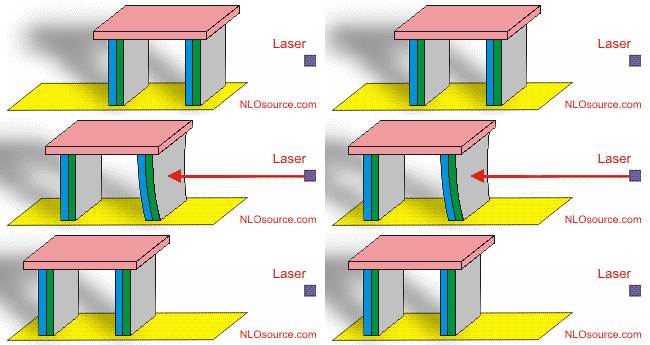
As I mentioned in a previous post, we were awarded a team grant to study smart morphing materials. This project, once in full swing, will most likely bring together a couple dozen people, including scientists, engineers, materials scientists, mathematicians, artists, educators, and teachers. There are several overlapping subgroups of people working on various aspects of this project, and I need to be involved in it all.
I am dedicating all day today to getting this project up and running. First, I need to get everyone connected so that each person sees his or her individual role in the project and how each person's work fits in with the whole. Each team member must learn the expertise available to them from other team members and outside collaborators. A bottom up approach is the most effective, but for this to effectively come together, the initial conditions need to be set.
This morning, I sent out an email to team members that read,
Dear All,
I am writing here to the full team in preparation for our meeting on
Thursday at 10:00am PDT. I am asking that all co-PIs add to the "Team
Members and Responsibilities" file in the shared DropBox folder BY THIS
FRIDAY AFTERNOON. Being on the East coast, [Member 1], perhaps you can start
the process since your day is almost over. After you are done, please
let [Member 2] and [Member 3] know it is their turn. If you have not yet
identified students/postdocs, you can pass on this step for now. We can
add them as they join the project.
Next is the more tricky part. After the team member file is done, I
would like everyone, at least on the technical part of the project -
including student/postdocs, to invite each other to their "Circles" on
Google+. To do so, all of you will need to open a (free) Google+
account first. I want to get this over with ASAP. For the technical
meetings, we may need to run two parallel Google Hangouts (one for
video) and one for slides/documents. If all team members have an
account, this will allow us the flexibility of having at least two
available accounts and computers at each site. It also will help us
to deal with computer problems. And since we want to encourage lots of
interactions between various subsets of the full team, getting us all
interconnected is a good start.
I'll send out a an agenda well before the meeting.
MGK
There are lots of individual issues that come up with each team member. This morning, the well-known wire artist and team member Elizabeth Berrian brought up several ideas and had additional administrative questions. The excerpt, below, from my email response shows all of the wonderful ideas that this project is generating.
Hi, Elizabeth,
No need to apologize for making contact with me. I enjoy new ideas,
perhaps to excess! I apologize for my tardy response. My emails tend
to back up as I work on absolute deadlines, so sometimes it may take a
day or two for me to respond.
Glad to hear that you are getting back to thinking about hinges and
making wire structures that have the capability of motion. You bring
up several interesting points.
Your musings remind me of how recent developments in Oragami have taken
off exponentially when the constraints of the process were translated
into mathematical terms. Rather than showing its limitations, the
mathematics revealed huge new realms of what was possible; and perhaps
most significantly, provided a guide as to how to implement new
structures, unleashing a new wave of creativity.
Your activities and proposals give me several ideas of how we can
proceed. It may be interesting to get a mathematician or theorist to
be involved in the process. First is the question of the basic
elements. They appear to be what I would call a "knot" which can't
move, a loop around a wire which can slide, etc. In more complex
structures, the way things are arranged, even without "knots" can make
it rigid and immovable. It may be interesting to try to break the
problem into basic elements. There is lots of work in topology that
does exactly this, so bringing this to bare on the problem might be
quite fruitful and fascinating.
Origami works under the constraint of using a single sheet. Similarly,
our technology requires a single strand of fiber that caries light
without interruption. As such, it would be interesting to try to
understand how this constraint plays out in the kinds of structures
that can be made. Optical fibers have the additional constraint that
bends radii must exceed some minimum value. Finally, there is the
connection between origami and wire art. For our purposes, we need to
understand how sheets can be folded onto a wire structure so that the
underlying support, when activated photo-mechanically, can make the
whole structure move in interesting and useful ways.
I would like to start working with the simplest structures to develop a
better intuition about the important ingredients for various
functions. It might be useful if you could make some rudimentary wire
structures on a small scale that exhibit the basic elements, and then
combine elements to see how they work together. This could guide us in
the types of fiber that we make in the future and the types of
applications that we target. Also, these activities could directly
impact the development of educational modules that teach both simple
concepts, such as coordinates in 3D space and geometry, to more
sophisticated concepts such as topology. It is thus important that we
document everything as meticulously as possible. I will try to set up
several dropbox folders so that we can share this information
seamlessly.
...
I will eventually set up individual meetings with the three of us, then
larger meetings with various subsets of the full group. I prefer
Google hangout, so in addition to Skype, it would be useful if you
could join Google+ (its free). Note that my priority this week is to
get the technical collaboration running, which involves coordinating
about a dozen people. This needs to be set in motion before our new
semester starts next week, which will add additional burdens. So, it
may be a few more days before I get around to contacting you again. Of
course, never hesitate to contact me. I always welcome ideas.
...
Looking forward to experiencing all the great things that this
collaboration will generate.
Below is an example of the exquisite wire art of Elizabeth Berrian.
I describe through diary-like entries why life as a physicist is fun -- even without fame and fortune.
Showing posts with label Ultra-Smart Morphing Materials. Show all posts
Thursday, August 15, 2013
Saturday, January 8, 2011
Genius and insanity
As I prepare for my colloquium that I will be giving at Case Western Reserve University, I have been thinking more broadly about smart materials. The morphing materials that I see in the far future are made of many integrated Photomechanical Optical Devices (PODs). As more nonlinear units are interconnected to enable interactions, the system becomes more intelligent - being able to process more information at greater levels of sophistication. At some point, one can imagine the system going through a transition to high-level intelligence, popularly referred to as emergence.
Interacting nonlinear systems are also known to become chaotic under certain conditions. As the complexity of a nonlinear system increases, so does its propensity for becoming chaotic. Highly intelligent humans are often quirky, and many geniuses are known to have been insane. This appears to be a universal quality of intelligence, whether its basis is in the interaction of neurons, electronic components, or PODs. While I often wonder if our creations will ultimately result in our doom, being an eternal optimist, I believe that our intellect will allow us to anticipate and mitigate disasters - provided that ideologues and politicians do not stand in the way.
Now that the semester is about to begin, my life is becoming chaotic. I have manuscripts to write, papers to review, proposals to write, deal with a plagiarist in my capacity as a journal editor, and classes to prepare; not to mention doing research and trying to generate an interesting thought in the midst of the mayhem. I don't know how I will get through the semester. The good news is that several papers have been accepted or are being returned with minor revisions. Life moves on...
Interacting nonlinear systems are also known to become chaotic under certain conditions. As the complexity of a nonlinear system increases, so does its propensity for becoming chaotic. Highly intelligent humans are often quirky, and many geniuses are known to have been insane. This appears to be a universal quality of intelligence, whether its basis is in the interaction of neurons, electronic components, or PODs. While I often wonder if our creations will ultimately result in our doom, being an eternal optimist, I believe that our intellect will allow us to anticipate and mitigate disasters - provided that ideologues and politicians do not stand in the way.
Now that the semester is about to begin, my life is becoming chaotic. I have manuscripts to write, papers to review, proposals to write, deal with a plagiarist in my capacity as a journal editor, and classes to prepare; not to mention doing research and trying to generate an interesting thought in the midst of the mayhem. I don't know how I will get through the semester. The good news is that several papers have been accepted or are being returned with minor revisions. Life moves on...
Thursday, September 30, 2010
Ultra-Smart Morphing Materials
Most of today's high-tech marvels are based on the tiny transistor, a device that controls the flow of electrical current. A transistor mediates the flow of one current depending on the properties of a second current. Since the interaction is nonlinear, a transistor can be used to amplify a weak signal, perform logic operations, and be used as a memory element. While a single transistor may be technologically unimpressive with regards to computing power, millions of them working together can perform amazing functionality that some day may meet the criteria of intelligence.
I envision a technology made of Photomechanical Optical Devices (PODs), each with the ability to control the flow of light based on the environment (stress, temperature, chemical agents, etc.), having multiple states for a given set of input parameters (i.e. optical and mechanical multi-stability), and having the ability to change shape based on the inputs. Integrating such devices together would lead to ultra-intelligent morphing materials/systems that would enable technologies that are yet to be invented. I have been dabbling with research in this area for 20 years.
The time is ripe to build the scientific foundations for making a novel new material/system that has the ability to morph in response to stress or light. In contrast to common materials that are made of atoms or molecules, and interact through electric fields, I envision a system made of microscopic units that each communicate with all others using light, imbuing it with enormous processing power and intelligence. Add to each unit the ability to respond to stress and perform actuation, and the system gains the ability to intelligently morph between complex structures. Miniaturization of such systems blurs the line between what is conventionally meant by a system and a material - terms that I use interchangeably.
Such materials would fill a new realm of applications. A series of pictures on a piece of film are projected onto a two-dimensional screen to show motion. A smart material, on the other hand, could be made to morph through a series of shapes leading to true 3-dimensional solid-body animations. For example, automobile designers could use them to continually change the shape of a model to test its aerodynamics or aesthetics; a chair could be made to automatically change shape to accommodate a particular body type; and an exact replica of an individual could be made in real time from information sent from a remote location, in effect recreating an animated three-dimensional solid replica of the sender. And you thought picture phones were great! Other applications would include noise cancellation wallpaper, reconfigurable air craft wings, ultra-stable platforms for precision manufacturing or characterization, and reconfigurable optical filters.
The development of such materials/systems would require extensive research aimed at demonstrating the fundamental building blocks, followed by studies of how a small number of them interact with each other when interconnected with light, and would culminate with the development of fabrication methods that could be used to make a bulk material from a collection of microscopic building blocks. Some aspects of the fundamental physics underlying this idea are in place; that is, photomechanical materials exist, interferometers with such materials can be built into polymer fibers, and a series of gratings can be written into a fiber, which in principle, could be made into a network of interacting units. The challenge lies in demonstrating classes of fundamental units that are naturally integratable, and understanding how to build a system from optimized units that work together to provide the desired function.
My vision of the fundamental building block is a waveguide-based feedback device, such as an interferometer, that is made in thin films or fibers, containing a nonlinear-optical and photomechanical material -- thus simultaneously having the ability to manipulate light, sense stress, and apply anisotropic stress to its surroundings. These PODs would simultaneously respond to optical and mechanical stimulus to yield mechanical/optical multistability, logic, stress/temperature sensing, optical/mechanical memory, positioning, and more. A network of PODs, interconnected by light signals along an integrated waveguide device would be scalable to a an ultra-smart material/system with functionality that goes well beyond present materials/systems paradigms. In contrast to a neural network, in which each neuron is connected to a small number of neighbors, a linear array of PODS along an optical fiber would interact with all others, processing information, reacting to stress and responding by selectively passing light and stressing the surroundings.
The development of this new technology may impact many future applications that have not yet been invented. Conversely, the novel materials concept may motivate new ideas for applications that have yet to be invented. I have submitted this idea to the National Science Foundation as part of a solicitation that seeks suggestions for new programs in areas that have the potential for transforming socienty. If NSF chooses not start a major program in ultra-smart morphing materials, I am hoping that this kind of research will someday be supported - even if I am not around to participate.
Subscribe to:
Posts (Atom)