Showing posts with label photomechanics. Show all posts

Sunday, June 26, 2022

What Have I Been up to?


People often wonder about what I do.  Physics professors such as me are eternally busy, often doing self-imposed work at all hours of the day, including weekends.  One of the advantages of a faculty position is the flexibility to take some little bits of time off here and there to recharge ones batteries.

When I pay myself summary salary from a grant, usually for no more than two months out of the three summer months, I end up working all of the time.  Summer provides the opportunity to catch up on research backlog, which builds up during the academic year due to teaching and service commitments.

A week ago, I took Monday off to drive up to our wilderness north of Spokane to work on installing a solar power collection system.  Even though I had worked through the weekend, it was difficult to pull myself away from all the accumulated commitments;  I had considered cancelling the trip several time until I got behind the wheel of my car.

The outing was worth it.  Working in the wilderness under blue skies and pure air rejuvenates the body and mind.  It's the only activity that completely removes even the slightest pang of anxiety from the pile-up of work demanding my attention.  Upon my return, I am more efficient and approach the tasks at hand with a reduced level of anxiety.

A glimpse of my recent activities can be gleaned for a narrative I was required to provide with my annual review materials.  It is reproduced below in its raw and unedited form.  Please excuse all of the typos and awkwardness, which is partially due to my distaste for having to write about my activities -- a process akin to holding one's breadth while trying to quickly empty the trash at the county landfill.

Here it is:

As described below, much of my work integrates teaching and research, making a fuzzy demarcation between the two, such as turning our research-grade apparatus into one that can be built by a high school student.

Research

Since the last review, I published 10 papers in six distinct refereed journals, all of them in the top tier of their specialty.  The work spans from fundamental quantum mechanics to applications and covers cutting-edge research, pedagogy, and broad-interest topics.  Highlights of the work follows.

The highest impact paper was a massive 170-page invited review article/tutorial that appeared in Advances in Optics and Photonics and covers the new emerging field of photomechanics.  A related invited paper, which included new research results, appeared in Journal of the Optical Society of America B.  Most recently we published a definitive paper on the mechanisms of the photomechanical effect in dye-doped polymer optical fibers, which appeared in Applied Sciences.  The latter work combines several experiments and varying conditions and two independent theories that together pin down the mechanisms with more confidence than would be possible with a single measurement and theory.  These three papers together position our group at WSU as a leader in the field.

On the pedagogy front, we published several articles in the American Journal of Physics.  One paper describes using a mobile phone for collecting data at home, enabling isolated students to do labs remotely.  A more fundamental paper elucidates subtle concepts underlying the Quantum no-cloning theorem and entanglement.  Finally, the paper on quantum length introduces new ideas and paradoxes that challenge our understanding of quantum mechanics and measurement.

A fundamental paper that describes a new method of using a proxy state to account for the quantum continuum appeared in Optics Letters while an applied paper on distributed Bragg fiber lasers that self-heal after burning out appeared in Applied Physics Letters, earning an Editors Choice recognition.  A  unique paper on how the nonlinear-optical response of novel hybrid quantum systems can be controlled with topology appeared in Journal of the Optical Society of America B.

Our visibility in the field of photomechanical materials and devices continues to increase with increased international exposure.  I gave the Keynote Address on the topic at the SPIE meeting in San Diego and presented an invited seminar at the Abu Dhabi Campus of New York University in the United Arab Emirates.  I have also been invited to speak at an international meeting in Cetraro, Italy on this topic.

I have been invited to guest-edit a special issue on photomechanical materials and applications for Applied Sciences and have already assembled an international team of co-editors.  This will enhance our visibility in the field. 

The quantum work continues to generate interest.  I presented our work on quantum NLO theory at the Foundations of nonlinear Optics as an invited speaker held at the Air Force Institute of Technology in Dayton, OH.

My work in fundamental quantum mechanics and pedagogy was presented in two Colloquiums: one at Colgate University and one at Skidmore College.  In addition to the technical presentation, I also presented an overview of our department and graduate program for recruitment purposes.

Our work over the past 10 years has focused on the physics of photomechanical materials and their applications, understanding the mechanism behind self-healing in dye-doped polymeric materials, and studying the quantum origins of the nonlinear-optic response.  We are in the process of transitioning into new areas while fortifying existing research strengths.

Taking advantage of the NLO Lab’s present strength in photomechanics, we are pursuing single-PI grants to support work with collaborators who make materials.  The near-term goal is to reinforce our interactions with international colleagues such as the exceptional groups at Tempere University in Finland and others in Morocco and Japan.  The long-term goal is to compete for larger grants.  The self-healing work, on the other hand, is attractive based on our past dominance in the field.  We have submitted a white paper to AFOSR, who share an interest in the topic.  However, we have experienced delays due to personnel changes at AFOSR.  Our group is still competitive in quantum nonlinear optics, so I plan on sending a proposal to NSF.  My efforts in the near future will focus on getting at least one of these three viable projects funded.

To leverage our unique abilities in quantum NLO, I am investing a significant effort in developing a framework for implementing quantum computing using nonlinear optics to color-entangle photons.  Given the large investment being made by the United States in quantum computing due to its importance to national security and competitiveness in the high-tech markets, the rewards are high but so are the risks.  I plan to focus most of my energy on this work throughout this calendar year and working on white papers with our larger physics-based team.

Teaching

I continue to teach undergraduate and graduate courses, advise graduate students in their masters and dissertation research, and advise undergraduates who are working on research and thesis projects.  Since 2018, I have graduated three PhD students and have served on numerous graduate thesis and dissertation committees.   Many of these students have been awarded mini-grants from within the university at the departmental and college level.  Traditional courses that I have taught over this period include Physics 320, Physics 533, Physics 534 and Physics 545.  I arranged for free licenses of Origin to be made available to students in Physics 320 and Physics 545 for class projects.  The first author in the American Journal of Physics publication on using cell phones for data was an undergraduate student whose research originated as a class project.  I also did similar projects with students taking the undergraduate seminar.

Service

I am active in service at all levels within the university and in my profession.  I advise the student chapters of OPTICA/SPIE, which do lots of outreach and run the laser maze during various university events.  I’m on the departmental committee for producing the APS video which will be used for recruitment, work with the College on undergraduate weekend recruitment presentations and have been involved in producing the departmental Comprehensive exam.

At the professional level I am on the editorial board or editor for several journals, act as a reviewer for more journals than I can count and have been awarded IOP trusted reviewer status.  The citation reads: “IOP trusted reviewer status acknowledges that you have demonstrated a high level of peer review competence, with the ability to critique scientific literature to an excellent standard.  You are one of our first reviewers to have achieved this status, so congratulations!”  I am active in organizing international conferences, two of which I founded: International Conference on Organic Nonlinear Optics (ICONO) and Foundations of Nonlinear Optics (FoNLO). 

Thursday, September 30, 2010

Ultra-Smart Morphing Materials


Most of today's high-tech marvels are based on the tiny transistor, a device that controls the flow of electrical current. A transistor mediates the flow of one current depending on the properties of a second current. Since the interaction is nonlinear, a transistor can be used to amplify a weak signal, perform logic operations, and be used as a memory element. While a single transistor may be technologically unimpressive with regards to computing power, millions of them working together can perform amazing functionality that some day may meet the criteria of intelligence.

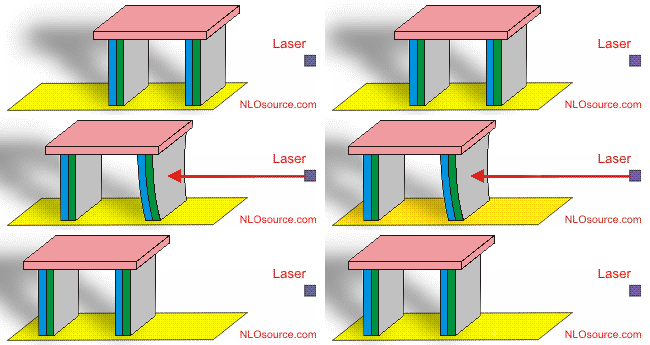
I envision a technology made of Photomechanical Optical Devices (PODs), each with the ability to control the flow of light based on the environment (stress, temperature, chemical agents, etc.), having multiple states for a given set of input parameters (i.e. optical and mechanical multi-stability), and having the ability to change shape based on the inputs. Integrating such devices together would lead to ultra-intelligent morphing materials/systems that would enable technologies that are yet to be invented. I have been dabbling with research in this area for 20 years.

The time is ripe to build the scientific foundations for making a novel new material/system that has the ability to morph in response to stress or light. In contrast to common materials that are made of atoms or molecules, and interact through electric fields, I envision a system made of microscopic units that each communicate with all others using light, imbuing it with enormous processing power and intelligence. Add to each unit the ability to respond to stress and perform actuation, and the system gains the ability to intelligently morph between complex structures. Miniaturization of such systems blurs the line between what is conventionally meant by a system and a material - terms that I use interchangeably.

Such materials would fill a new realm of applications. A series of pictures on a piece of film are projected onto a two-dimensional screen to show motion. A smart material, on the other hand, could be made to morph through a series of shapes leading to true 3-dimensional solid-body animations. For example, automobile designers could use them to continually change the shape of a model to test its aerodynamics or aesthetics; a chair could be made to automatically change shape to accommodate a particular body type; and an exact replica of an individual could be made in real time from information sent from a remote location, in effect recreating an animated three-dimensional solid replica of the sender. And you thought picture phones were great! Other applications would include noise cancellation wallpaper, reconfigurable air craft wings, ultra-stable platforms for precision manufacturing or characterization, and reconfigurable optical filters.

The development of such materials/systems would require extensive research aimed at demonstrating the fundamental building blocks, followed by studies of how a small number of them interact with each other when interconnected with light, and would culminate with the development of fabrication methods that could be used to make a bulk material from a collection of microscopic building blocks. Some aspects of the fundamental physics underlying this idea are in place; that is, photomechanical materials exist, interferometers with such materials can be built into polymer fibers, and a series of gratings can be written into a fiber, which in principle, could be made into a network of interacting units. The challenge lies in demonstrating classes of fundamental units that are naturally integratable, and understanding how to build a system from optimized units that work together to provide the desired function.

My vision of the fundamental building block is a waveguide-based feedback device, such as an interferometer, that is made in thin films or fibers, containing a nonlinear-optical and photomechanical material -- thus simultaneously having the ability to manipulate light, sense stress, and apply anisotropic stress to its surroundings. These PODs would simultaneously respond to optical and mechanical stimulus to yield mechanical/optical multistability, logic, stress/temperature sensing, optical/mechanical memory, positioning, and more. A network of PODs, interconnected by light signals along an integrated waveguide device would be scalable to a an ultra-smart material/system with functionality that goes well beyond present materials/systems paradigms. In contrast to a neural network, in which each neuron is connected to a small number of neighbors, a linear array of PODS along an optical fiber would interact with all others, processing information, reacting to stress and responding by selectively passing light and stressing the surroundings.

The development of this new technology may impact many future applications that have not yet been invented. Conversely, the novel materials concept may motivate new ideas for applications that have yet to be invented. I have submitted this idea to the National Science Foundation as part of a solicitation that seeks suggestions for new programs in areas that have the potential for transforming socienty. If NSF chooses not start a major program in ultra-smart morphing materials, I am hoping that this kind of research will someday be supported - even if I am not around to participate.

Wednesday, August 18, 2010

When the lights go out in Budapest

After a kind introduction by one of the conference organizers, I presented the Monday afternoon plenary lecture at ICOOPMA 2010, an international meeting on optical materials and technologies. Budapest is a beautiful city rich in history and culture, but also the host to the horrors of World War II. The lecture hall, which was a large room in the lower level adjacent to a pool and reception area, could have been anywhere.

The gentle hum of the air conditioning system was barely perceptible, as it toiled to protect the room from the hot and muggy air that blanketed the city. My wife and I had traveled almost a full day to get to Budapest from Pullman, albeit in the relative comfort of business class, courtesy of a complimentary upgrade from Delta Airlines. The five star Intercontinental Continental Hotel provided a tad of luxury at a bargain price of $49 per night, thanks to Hotwire.com. But the purpose of my trip was to attend the meeting and to give my talk.

With 25 years of public speaking experience, I am pretty calm in front of crowd, but only when talking about physics. Ask me to say a few words at a wedding or a family event, and I am barely able to stammer out a few words before feeling sick. Physics provides the ultimate comfort. The enjoyment of presenting my work is akin to a parent bragging about the accomplishments of a child. But pride is not an accurate characterization of the feeling. It's more of a mutual admiration for the beauty and depth of how mother nature has written her story in the fabric of our universe. I am merely the story teller.

I derive great satisfaction in sharing insights with a couple hundred scientists, many of them strangers, but all having in common an appreciation of the beauty of the physical world, and the potential for new wonders that it offers.

``So as you can see, the Photomechanical Optical Device represents the 5 device classes, but using only optics rather than electronics..." My trance-like state was briefly interrupted by the rumble of distant thunder. I continued to present my talk with great excitement. A second bolt shook the building, the lights faltered, then the room went dark for an instant until the emergency backup power kicked in. The main transformer for one region of the city was fried, leaving a nonfunctional projector for the second half of my Power Point presentation.

I continued to speak, waving my hands, and making air drawings to get though the remaining part of my talk. While the lack of visuals undoubtedly detracted from the information that I tried to convey, it made my talk more memorable than if all had gone smoothly.

At the end, I fielded many questions and comments - a sign that people were listening and were interested in the topic. After the Q&A, the conference organizers presented me with a bottle of Chardonnay with a special label sporting my name and the conference's name and coordinates. I was also given a Rubik's cube, which I believe was invented by a Hungarian. After the event was over, several more people hung around to ask questions and make comments.

We hailed a cab back to the hotel, and prepared for our return trip, which commenced with a 3:00am wake-up call and a 4:00am shuttle to the airport. We ended up missing a connection that prolonged our travels over eight hours. In the end, I was satisfied with the trip - not because I could add another destination to my list of travels, but for the opportunity to share with others the work that I love. We will be landing in Seattle in an hour, and will make the 5-hour drive to Pullman, getting us home by about 3:00am. The stresses associated with the start of an academic year will be upon us when we awaken, but I am also looking forward to all the new results awaiting me in the minds and notebooks of my students and collaborators.

I can't wait to get home!