Showing posts with label PODs. Show all posts

Tuesday, February 8, 2011

Good news comes in threes or fours (or fives!)

In the fall, I wrote of my despair when hearing about three papers that had been rejected, all in the same week. Finally, all of these papers are in various stages of the publication process.

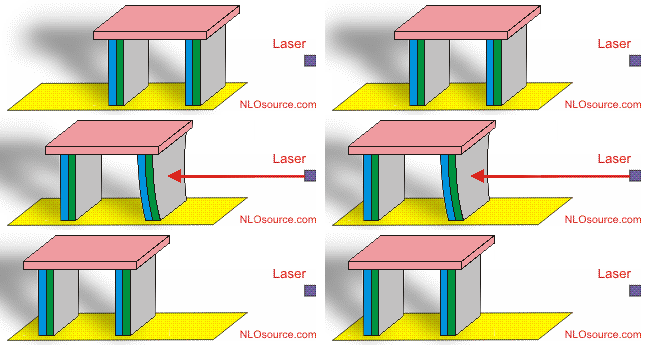
First, our paper on photo-mechanical optical devices (which we call PODs), just appeared in Optics Communications this month, which you can view by clicking here. I have talked about this work at several conferences, and I am getting very positive feedback. I am hoping to get this work funded in the near future. I believe that breakthroughs in this area could lead to amazing new technologies that will excite even the most jaded techies.

Secondly, the paper that got the nasty review, which I described in my post The Good, the Bad, and the Nasty, just got accepted. The letter from the editor is appended to this post.

A recent paper that we submitted to Advanced Materials, a high-impact journal, just appeared in print. This is a comment that my former student and colleague Javier Perez-Morena and I wrote on the work of some of our colleagues from Australia. We showed that their results were even more important than they originally thought - a happy outcome for all!

I learned about all three good news items this morning.

Finally, our paper on imaging studies of self-healing will appear shortly in the Journal of the Optical Society of America B. In addition, we have several papers that are in various stages of preparation and under review. New trials and tribulations surely await us!

***Update*** After all of this good news, I was pleased to learn of a fifth item of good news. In a previous post, I had talked about our newest Monte Carlo work, which we submitted to JOSA B. I just heard from Shoresh that this paper was accepted for publication with optional minor revisions. For once, the reviewers and I agree!

Letter from Journal of Chemical Physics

February 8, 2011

Title: The effect of electron interactions on the universal properties of systems with optimized off-resonant intrinsic hyperpolarizability

Author(s): David Watkins and Mark Kuzyk

Professor Mark G. Kuzyk
Washington State University
Department of Physics and Astronomy
Post Office Box 642814
Pullman, WA 99164-2814


Dear Professor Kuzyk,

The above manuscript has been accepted for publication in the Journal of Chemical Physics. You may receive requests from our office to ensure that all manuscript files are complete and suitable for typesetting. Once the manuscript files are in an acceptable format, they will be forwarded to the American Institute of Physics publication office.

This e-mail is the only notification you will receive of the acceptance of your paper. If you have questions about the production of your manuscript, you may find contact information for AIP production staff at...


No revisions of the manuscript can be made before the galley proof stage.

Sincerely yours,

Letter from Advanced Materials

Dear Dr. Perez-Moreno,

We are pleased to inform you that your Comment

"A Correspondence on "Organometallic Complexes for Nonlinear Optics. 45.
Dispersion of the Third-Order Nonlinear Optical Properties of Triphenylamine-Cored Alkynylruthenium Dendrimers". Increasing the Nonlinear
Optical Response by Two Orders of Magnitude." by Javier Perez-Moreno, Javier Perez-Moreno
Mark G. Kuzyk
has now been published online.


Your article is available from http://dx.doi.org/10.1002/adma.201003421

The citation data and abstract (if applicable) are available free of charge from the same link; access to the full text may require a subscription.
Please use the above-mentioned URL to link to the article from your institutional homepage, e.g., on publication lists.

A reference to your article is also available from your personal homepage by selecting "Author" and then "My Published Articles".


Best wishes,

Advanced Materials
(Editorial Office)

Saturday, January 8, 2011

Genius and insanity

As I prepare for my colloquium that I will be giving at Case Western Reserve University, I have been thinking more broadly about smart materials. The morphing materials that I see in the far future are made of many integrated Photomechanical Optical Devices (PODs). As more nonlinear units are interconnected to enable interactions, the system becomes more intelligent - being able to process more information at greater levels of sophistication. At some point, one can imagine the system going through a transition to high-level intelligence, popularly referred to as emergence.

Interacting nonlinear systems are also known to become chaotic under certain conditions. As the complexity of a nonlinear system increases, so does its propensity for becoming chaotic. Highly intelligent humans are often quirky, and many geniuses are known to have been insane. This appears to be a universal quality of intelligence, whether its basis is in the interaction of neurons, electronic components, or PODs. While I often wonder if our creations will ultimately result in our doom, being an eternal optimist, I believe that our intellect will allow us to anticipate and mitigate disasters - provided that ideologues and politicians do not stand in the way.

Now that the semester is about to begin, my life is becoming chaotic. I have manuscripts to write, papers to review, proposals to write, deal with a plagiarist in my capacity as a journal editor, and classes to prepare; not to mention doing research and trying to generate an interesting thought in the midst of the mayhem. I don't know how I will get through the semester. The good news is that several papers have been accepted or are being returned with minor revisions. Life moves on...

Thursday, September 30, 2010

Ultra-Smart Morphing Materials


Most of today's high-tech marvels are based on the tiny transistor, a device that controls the flow of electrical current. A transistor mediates the flow of one current depending on the properties of a second current. Since the interaction is nonlinear, a transistor can be used to amplify a weak signal, perform logic operations, and be used as a memory element. While a single transistor may be technologically unimpressive with regards to computing power, millions of them working together can perform amazing functionality that some day may meet the criteria of intelligence.

I envision a technology made of Photomechanical Optical Devices (PODs), each with the ability to control the flow of light based on the environment (stress, temperature, chemical agents, etc.), having multiple states for a given set of input parameters (i.e. optical and mechanical multi-stability), and having the ability to change shape based on the inputs. Integrating such devices together would lead to ultra-intelligent morphing materials/systems that would enable technologies that are yet to be invented. I have been dabbling with research in this area for 20 years.

The time is ripe to build the scientific foundations for making a novel new material/system that has the ability to morph in response to stress or light. In contrast to common materials that are made of atoms or molecules, and interact through electric fields, I envision a system made of microscopic units that each communicate with all others using light, imbuing it with enormous processing power and intelligence. Add to each unit the ability to respond to stress and perform actuation, and the system gains the ability to intelligently morph between complex structures. Miniaturization of such systems blurs the line between what is conventionally meant by a system and a material - terms that I use interchangeably.

Such materials would fill a new realm of applications. A series of pictures on a piece of film are projected onto a two-dimensional screen to show motion. A smart material, on the other hand, could be made to morph through a series of shapes leading to true 3-dimensional solid-body animations. For example, automobile designers could use them to continually change the shape of a model to test its aerodynamics or aesthetics; a chair could be made to automatically change shape to accommodate a particular body type; and an exact replica of an individual could be made in real time from information sent from a remote location, in effect recreating an animated three-dimensional solid replica of the sender. And you thought picture phones were great! Other applications would include noise cancellation wallpaper, reconfigurable air craft wings, ultra-stable platforms for precision manufacturing or characterization, and reconfigurable optical filters.

The development of such materials/systems would require extensive research aimed at demonstrating the fundamental building blocks, followed by studies of how a small number of them interact with each other when interconnected with light, and would culminate with the development of fabrication methods that could be used to make a bulk material from a collection of microscopic building blocks. Some aspects of the fundamental physics underlying this idea are in place; that is, photomechanical materials exist, interferometers with such materials can be built into polymer fibers, and a series of gratings can be written into a fiber, which in principle, could be made into a network of interacting units. The challenge lies in demonstrating classes of fundamental units that are naturally integratable, and understanding how to build a system from optimized units that work together to provide the desired function.

My vision of the fundamental building block is a waveguide-based feedback device, such as an interferometer, that is made in thin films or fibers, containing a nonlinear-optical and photomechanical material -- thus simultaneously having the ability to manipulate light, sense stress, and apply anisotropic stress to its surroundings. These PODs would simultaneously respond to optical and mechanical stimulus to yield mechanical/optical multistability, logic, stress/temperature sensing, optical/mechanical memory, positioning, and more. A network of PODs, interconnected by light signals along an integrated waveguide device would be scalable to a an ultra-smart material/system with functionality that goes well beyond present materials/systems paradigms. In contrast to a neural network, in which each neuron is connected to a small number of neighbors, a linear array of PODS along an optical fiber would interact with all others, processing information, reacting to stress and responding by selectively passing light and stressing the surroundings.

The development of this new technology may impact many future applications that have not yet been invented. Conversely, the novel materials concept may motivate new ideas for applications that have yet to be invented. I have submitted this idea to the National Science Foundation as part of a solicitation that seeks suggestions for new programs in areas that have the potential for transforming socienty. If NSF chooses not start a major program in ultra-smart morphing materials, I am hoping that this kind of research will someday be supported - even if I am not around to participate.

Thursday, August 12, 2010

Kicking Around New Ideas

For a couple months now, we have been struggling with calculations of the nonlinear-optical response of quantum wires. Our idea is to build up complex structures by connecting together pieces of straight wire segments. The problem is that the sum rules appear to have pathologies. But in reality, the problems lie in the way that we idealize the wire.

As I discussed in a previous post, the case of the quantum rotor is a specific example that had been treated rigorously by Stavros Fallieros. I had an idea of how to apply a similar argument to a straight section of wire. The upshot is that along a wire, the sum rules hold. The problem with an idealized one-dimensional wire is that the wave function is by definition confined to the wire, and therefore vanishes outside. By the Heisenberg uncertainty principle, a particle that is confined in that way must have an infinite transverse momentum, implying an infinite energy state.

If these infinite energy states are included, the sum rules are obeyed. I came up with a simple textbook approach that models transverse confinement with a Dirac delta function potential in the limit when the strength of the delta function is infinite. While I had not solved the full problem, I wrote up the concept in a file LaTeX where I wrote out the form of the solutions. Then, I passed the document along to my students for them to do the hard part: evaluating infinite sums of complicated expressions in the limit when various parameters are large and small. Since there are no loopholes in the way the sum rules are derived, I am confident that this approach will work.

The other day, after I emailed this file to the students, we had a spirited debate. They disagreed with my approach and gave all sorts of counterarguments to prove me wring. They constructed special cases that seemed airtight arguments against my approach. But slowly, they became convinced; not because I am the expert, but because my argument is sound. This is one of the most satisfying aspects of the community of science. In the end, reason wins. This time, I may have been vindicated, but I have made enough mistakes in the past to not be overly dejected when I am proven wrong. Being scientists requires us to admit error.

As an update to one of our papers that was initially rejected, in the process of responding to a substantive comment made by one of the reviewers, David Watkins found an intrinsic hyperpolarizability that exceeds unity - an impossibility, according to my theory. Though my theory has been tested over an over again using different computational techniques under a broad range of conditions, I panic when it appears that I might have missed something. David and I sent many emails back and forth on the topic, trying to understand if somehow the sum rules were being violated by the new case under study. To my delight, David found and fixed a couple of bugs in his code, which solved the problem. The results for this new case is now consistent with all our other calculations.

On another front, three students from my nonlinear optics class and I had finished a nice paper on cascading at the beginning of the summer. As I had reported in a previous post, just prior to submitting the paper, we had found a case where the fundamental limits were exceeded. Since then, we have tried all sorts of approaches to reconcile the problem, but to no avail. Nathan, the lead student on the project, believes that cascading is a way to beat the limits. However, based on general principles, I know the limits must hold. And it's not that I want my theory to be true, but, based on general arguments, the cascading results - which are a special case - must agree with the more general theory. If a specific case appears to violate the more general one, it is incumbent upon us to track down the source of the inconsistency. In other words, we have to specifically show how this case falls outside the realm of the theory. At this point, cascading seems to be formulated in a way that makes it a simple subset of the more general theory.

I have been writing much about theory, but our experimental work has been going well. Shiva has built a beautiful temperature-controlled chamber that will allow him to do experiments from temperatures well bellow ambient to over 100 C. Since the temperature-dependence of a measurement provides a window into the energetics of a process, we hope the new experiments will provide us with a clue as to the metastable species involved that usher self heal self healing of a molecule upon photodegradation. In parallel, I am trying to work out a general theory of self-healing based on our past observations. The real test of this theory will be its power to predict the behavior of new observations as better experiments push the envelope of our knowledge. As a sneak preview, the theory includes a recovery process that is akin to stimulated emission, but in the case of dye recovery, has to do with coupling between the guest molecules and phonons in the host polymer.

Prabodh, a new graduate student in our group is specializing in making a large variety of samples so that he can study how the dopant and polymer host affect the healing process. Ben is doing a a series of experiments to optically image the damaged areas to better pin down the population dynamics, and he is building a new experiment that will allow us to determine the absorption spectrum at each point in the damage region. The combination of new samples and new measurements will provide valuable complimentary data that will undoubtedly aid us in unraveling the puzzle of self healing.

Nathan is getting additional data on the photomechanical response that appears to be consistent with our models. While the results are giving us insights into the new class of liquid crystal elastomeric materials, our conclusions appear to be at odds with those of our collaborators, who supplied us with the samples. I am confident that we will eventually reach a consensus because the truth always bubbles to the top. Even if we are proven right, we most likely have only part of the answer. More interesting mysteries are undoubtedly lurking at the next layer of depth.

Xianjun is in the process of calculating the response of Photomechanical Optical Devices (PODs), with the goal of predicting how they will behave when acting in series. This is a highly nonlinear problem, with complex solutions. At this stage, we are still struggling with the relatively simple things, like the response of a single nonlinear etalon. More complex systems will require us to consider more subtle issues and to be clever in our approximations to solving the full problem. In parallel, Xianjun is starting experiments to burn Bgragg gratings in polymer optical fibers with the goal of making and characterizing PODs. Measurements will play an indispensable part in developing our numerical models.

I hve more to write, but our flight to Amsterdam is boarding. This long trip will eventually lead us to Budapest, where I am giving a plenary lecture on self healing and photo mechanical effects. I apologize for any typos that resulted from my haste, and will write about the meeting upon my return.