Showing posts with label photomechanical effect. Show all posts

Wednesday, December 29, 2021

Publications, Metrics and Reputation

 Here is an email I sent to my students about publications and reputation based on a recent paper that just appeared online.  I have removed names to conceal the names of parties that might prefer to remain anonymous.

Dear all,

A conversation about publications often comes up between graduate students and their research mentors.  I know that we have talked about this multiple times.  A valid concern of many students is the strength of their publications record, which is used by future academic employers.  It is easy to count numbers of publications or metrics such as the h-index, but an individual’s reputation is based on substance not simplistic numbers.

First, the research itself must be interesting and useful to others.  There are many papers that wow me even if I never cite them in my own research, winning my highest respect for those who create such gems.  You should work hard and enjoy the process of making new discoveries, and then hold yourselves to the highest standards for the work that you produce.  This is what will open doors to future employment.

The email below from one of my colleagues serves as an example of the reputation that you should seek to build over time.  I hope that this kind of feedback motivates you to persevere through the next phase of your work.  I certainly look forward to all the new insights that we will gain.

To conclude, I congratulate you for your contributions to this work.  I know that some of you were frustrated having to rebuild experiments, repeat measurements, and rewrite the manuscript an endless number of times as we found errors in the calculations and problems with the apparatus.  But in the end, I am proud of the final product, which I believe will be of use to others.

Happy New Year!


Best,

Mark G. Kuzyk

Regents Professor of Physics

Washington State University

Pullman, WA 99164-2814


Phone: 509-335-4672

Fax: 509-335-7816


Web Page: www.NLOsource.com


From: [Colleague]
Sent: Wednesday, December 29, 2021 9:11 AM
To: Kuzyk, Mark G <kuz@wsu.edu>; Mark G. Kuzyk <mgk.wsu@gmail.com>
Subject: Fwd: [Applied Sciences] Manuscript ID: applsci-1500266; doi: 10.3390/app12010315. Paper has been published.

Dear Mark,

I forwarded this new paper to my group members. You never cease to amaze me with the thoroughness and rigor of your research. What an amazing piece this last report is! We have a lot to learn from you, indeed.

I will enjoy reading the paper. I hope we can meet up at some point to continue our discussions. [My senior student] will be graduating in January and he wants to pursue a career in the corporate world. I have another student who is a bright and enthusiastic, and we can consider sending him to your lab, if the things with the pandemic get better.

Take care of your health,

[Colleague]

---------- Forwarded message ---------
From: Applied Sciences Editorial Office <applsci@mdpi.com>
Date: Wed, Dec 29, 2021 at 5:02 PM
Subject: [Applied Sciences] Manuscript ID: applsci-1500266; doi: 10.3390/app12010315. Paper has been published.
To: Colleague
Cc: Applied Sciences Editorial Office <applsci@mdpi.com>, Keira Wang <keira.wang@mdpi.com>

Dear [Professor],


We are pleased to inform you that "Photothermal and Reorientational
Contributions to the Photomechanical Response of DR1 Azo Dye-Doped PMMA
Fibers" by Zoya Ghorbanishiadeh, Bojun Zhou, Morteza Sheibani Karkhaneh,
Rebecca Oehler, Mark G. Kuzyk * has been published in Applied Sciences as
part of the Special Issue Composite and Smart Materials: Theory, Methods and
Applications and is available online:

Abstract: https://urldefense.proofpoint.com/v2/url?u=https-3A__www.mdpi.com_2076-2D3417_12_1_315&d=DwIDaQ&c=slrrB7dE8n7gBJbeO0g-IQ&r=8Rjnp4aNhHPBrmgt9k4Q6f-pu3z01qzkXZBySmc4rd8&m=o0b_FSbvMnSOnSSq65_Iqvm2Lzwws_d1R8DePemMmvVRGF0JjKCizRgc6-aV4Ati&s=NKk5yL3BySXUrbhhOaPR0aUISAStEHsLXfIt9ZbVctk&e=
HTML Version: https://urldefense.proofpoint.com/v2/url?u=https-3A__www.mdpi.com_2076-2D3417_12_1_315_htm&d=DwIDaQ&c=slrrB7dE8n7gBJbeO0g-IQ&r=8Rjnp4aNhHPBrmgt9k4Q6f-pu3z01qzkXZBySmc4rd8&m=o0b_FSbvMnSOnSSq65_Iqvm2Lzwws_d1R8DePemMmvVRGF0JjKCizRgc6-aV4Ati&s=t6QVhD-mbZqQY846ZCCoE2JzF67xY6qSi5A7TOImY3k&e=
PDF Version: https://urldefense.proofpoint.com/v2/url?u=https-3A__www.mdpi.com_2076-2D3417_12_1_315_pdf&d=DwIDaQ&c=slrrB7dE8n7gBJbeO0g-IQ&r=8Rjnp4aNhHPBrmgt9k4Q6f-pu3z01qzkXZBySmc4rd8&m=o0b_FSbvMnSOnSSq65_Iqvm2Lzwws_d1R8DePemMmvVRGF0JjKCizRgc6-aV4Ati&s=KrUea9tNwtMeC4JC2sXiRHNYB_UMo3nUyRQqeZfdlq4&e=
Special Issue:
https://urldefense.proofpoint.com/v2/url?u=https-3A__www.mdpi.com_journal_applsci_special-5Fissues_composite-5Fsmart-5Fmaterials&d=DwIDaQ&c=slrrB7dE8n7gBJbeO0g-IQ&r=8Rjnp4aNhHPBrmgt9k4Q6f-pu3z01qzkXZBySmc4rd8&m=o0b_FSbvMnSOnSSq65_Iqvm2Lzwws_d1R8DePemMmvVRGF0JjKCizRgc6-aV4Ati&s=8xdNAgcPAFbBFvgIf7SzfgeGSZTqc2tWgqC4aTa4zB4&e=


Wednesday, December 22, 2021

New Insights into the Obvious

The number of posts I publish here tends to rise around the holidays, when demands on my time temporarily wane, giving me time to think about interesting topics and reflect on life.  I reread a post from a while back, which talked about my frustrations with the hectic nature of my job and my desire to spend more time on deeper thought.  Click here for that post.  My goal was to understand some of the deeper consequences of quantum mechanics and how it underpins thermodynamics/statistical mechanics.

I have approached this goal over the last half decade by rethinking the most basic foundations of quantum mechanics; those topics that students quickly leapfrog to progress to the next stage of solving real research problems.  I find the need to build my intuition by mulling over these basics, perseverating over them until the meaning infuses my brain.  Once it becomes second nature, I can build on these foundations.

In the process skimming through typical textbooks, I found that the connection between quantum mechanics and density operators is not well made.  So, I wrote a simple two-page manuscript with a simple example that illustrates the important facts and submitted it to the American Journal of Physics.  One of the reviewers stated, “Reading this very short and sweet manuscript taught me something about density operators that I did not appreciate before; something that seems vitally important for both students -and- the general interested physicist to understand…

“The main thing I learned by reading this manuscript is that the apparent classical mixture form of the density matrix -always- originates from a purely quantum effect - entanglement with the environment. I almost cannot believe that I did not appreciate that before - interaction with the environment is certainly presented as the main issue to be solved in any open quantum system textbook. But the formalism obscures this, and I think I had come away with the impression that at least in some cases, the density matrix was really just used to represent a classical mixture. The use of the simple example here makes it extremely intuitive and obvious, which I think is just as the authors intended. However, I suggest three changes that I think will make this manuscript even better...

I find AJP a wonderful journal, authored and read by people who enjoy learning and appreciate new insights or an unexpected twist on a well-worn topic.

At the other extreme, we just had a paper accepted that developed two different models of how light can affect the mechanical properties of matter and used these models to interpret experiments to determine the underlying mechanisms.

This break I plan on continuing my work on a new project related to quantum computing, which is particularly exciting to me because it will require learning a lot of new material.

Stay tuned!


Monday, July 18, 2011

A silver lining

We have been visiting with family in the Philadelphia area. What should have been a fun time has been colored with tension and anxiety. First, there is the issue of what to do with my 95-year-old father.

He is highly independent, living on his own, cooking for himself, and competently driving a car. He and his buddies (all younger than him) occasionally drive to Cape May - a Victorian beach town. Also, he volunteers twice a week to work at the senior lunch, collecting the $1.50 cost of the meal, and making sure that the books are balanced. He even helps deliver food to the eighty-year olds with walkers.

Ten years ago, we built an addition to our home for my father. He refused to move in. I don't blame him. He has friends and activities to keep him busy. He participates in all sorts of events at the Ukrainian church and the Ukrainian Center. Pullman, on the other hand, has zero Ukrainians for him to befriend. Though we are there for him, work is a large part of our days, so he would be bored to death most of the time. In Philly, he is an active part of his microcommunity participating in his ethnic culture that he cherishes.

My father is concerned that his driver's license will not be renewed, rendering his present lifestyle impossible. We are also concerned that as he ages, he will become less independent. Our agonizing decision comes down to a choice between him continuing to live alone with the chance that he may injure himself, but otherwise a happy life; or, moving him to Pullman, and dooming him to certain misery. In my mind, both choices are far from ideal.

The other day, my father fell as a result of a dizzy spell. He was bruised but otherwise seemed unharmed. However, it was painful for him to walk, and his nurse (who visits him occasionally at home for blood tests), recommended that he get an X-ray to rule out a fractured hip. Fortunately, we had made plans to have lunch with good friends from Yardley. After lunch, John - an orthopedic surgeon, and his wife Camille - a physical therapist, checked my father's injuries and ordered X-rays as a precaution. The local hospital quickly determined that he had not sustained serious injury.

This whole process reminded us of my father's situation and the painful decisions ahead. Unfortunately, every option other than the status quo is unacceptable to him: No to senior living homes, no to roommates, no to moving to Pullman, etc. For now, we are making arrangements to simplify his daily routine, but some day, we will need to bring him to Pullman, kicking and screaming.

We have been driving extensively to get between my fathers place, and the various in-laws. As a result, I have been feeling depressed and anxious about not having time to work, not to mention my motion sickness. Yesterday afternoon, after arriving at my sister-in-law's vacation home in Delaware, I finally sat down at my computer to work, only to come down with a debilitating migraine headache that put me out of commission for the rest of the evening.

This morning, I awoke feeling physically well, but mentally exhausted with thoughts of the piles of work that has accumulated. As I was working, I got two pieces of good news:

First, I was notified that my NSF proposal on sum rules has been recommended for funding. However, there are several questions that I first need to address before approval. This will be my first priority, so my other work will need to wait.

While reading through the email from NSF, I got notification that a third paper on Nathan's work on photo mechanical liquid crystal elastomers was accepted. An excerpt of comments from each reviewer follows.

REVIEWER 1

The manuscript provides an in-depth model and related discussion on the deformation mechanism of azo containing liquid crystal elastomer upon a light trigger. The authors incorporated in the model heat effects as related to absorption and diffusion during and after exposure in the absorption band of the azo compound. To my opinion this was the first time that it was described so extensively rather than mentioning that heat effects might also play role next to the photo-isomerization reaction. For this reason it is my opinion that the paper should be published in the Journal of the Optical Society of America...

REVIEWER 2

In the manuscript “Modeling the mechanisms of the photomechanical response of a nematic liquid crystal elastomer”, authors have done the modeling to explain the plausible mechanisms involved in photomechanical response of nematic liquid crystal elastomer. In the previous report: N. J. Dawson et al., J. Opt. Soc. Am. B 28, 1916 (2011), authors have reported the experimental determination of mechanisms of photomechanical effects in a nematic liquid crystal elastomer in a particular device geometry. More interestingly, in the present report the models have been initially proposed and then used to compare with experimental results and to evaluate related material parameters. Undoubtedly, the theoretical modeling, comparison with experimental results and related explanations are up to the mark. Moreover, the report does not only demonstrate the fundamental mechanisms but also provide the platform for design of optical devices based on photomechanical effect and hence seems to be greatly useful for liquid crystal community as well as other related fields.

On the basis of the originality and novelty of the work presented in this report, I feel that it would be really of worth to keep this article in JOSA B. Therefore, I recommend it for the publication in JOSA B.

While life throws all sorts of crap our way, I take great comfort in the fact that I will be able to continue my work in sum rules, and how they elucidate the nature of light matter interactions. Future work in this area, while remaining on the esoteric side, is converging on ideas that will impact practical applications. These thoughts temporarily allow me to escape form my wories.

Gotta pack and run...

Thursday, September 30, 2010

Ultra-Smart Morphing Materials


Most of today's high-tech marvels are based on the tiny transistor, a device that controls the flow of electrical current. A transistor mediates the flow of one current depending on the properties of a second current. Since the interaction is nonlinear, a transistor can be used to amplify a weak signal, perform logic operations, and be used as a memory element. While a single transistor may be technologically unimpressive with regards to computing power, millions of them working together can perform amazing functionality that some day may meet the criteria of intelligence.

I envision a technology made of Photomechanical Optical Devices (PODs), each with the ability to control the flow of light based on the environment (stress, temperature, chemical agents, etc.), having multiple states for a given set of input parameters (i.e. optical and mechanical multi-stability), and having the ability to change shape based on the inputs. Integrating such devices together would lead to ultra-intelligent morphing materials/systems that would enable technologies that are yet to be invented. I have been dabbling with research in this area for 20 years.

The time is ripe to build the scientific foundations for making a novel new material/system that has the ability to morph in response to stress or light. In contrast to common materials that are made of atoms or molecules, and interact through electric fields, I envision a system made of microscopic units that each communicate with all others using light, imbuing it with enormous processing power and intelligence. Add to each unit the ability to respond to stress and perform actuation, and the system gains the ability to intelligently morph between complex structures. Miniaturization of such systems blurs the line between what is conventionally meant by a system and a material - terms that I use interchangeably.

Such materials would fill a new realm of applications. A series of pictures on a piece of film are projected onto a two-dimensional screen to show motion. A smart material, on the other hand, could be made to morph through a series of shapes leading to true 3-dimensional solid-body animations. For example, automobile designers could use them to continually change the shape of a model to test its aerodynamics or aesthetics; a chair could be made to automatically change shape to accommodate a particular body type; and an exact replica of an individual could be made in real time from information sent from a remote location, in effect recreating an animated three-dimensional solid replica of the sender. And you thought picture phones were great! Other applications would include noise cancellation wallpaper, reconfigurable air craft wings, ultra-stable platforms for precision manufacturing or characterization, and reconfigurable optical filters.

The development of such materials/systems would require extensive research aimed at demonstrating the fundamental building blocks, followed by studies of how a small number of them interact with each other when interconnected with light, and would culminate with the development of fabrication methods that could be used to make a bulk material from a collection of microscopic building blocks. Some aspects of the fundamental physics underlying this idea are in place; that is, photomechanical materials exist, interferometers with such materials can be built into polymer fibers, and a series of gratings can be written into a fiber, which in principle, could be made into a network of interacting units. The challenge lies in demonstrating classes of fundamental units that are naturally integratable, and understanding how to build a system from optimized units that work together to provide the desired function.

My vision of the fundamental building block is a waveguide-based feedback device, such as an interferometer, that is made in thin films or fibers, containing a nonlinear-optical and photomechanical material -- thus simultaneously having the ability to manipulate light, sense stress, and apply anisotropic stress to its surroundings. These PODs would simultaneously respond to optical and mechanical stimulus to yield mechanical/optical multistability, logic, stress/temperature sensing, optical/mechanical memory, positioning, and more. A network of PODs, interconnected by light signals along an integrated waveguide device would be scalable to a an ultra-smart material/system with functionality that goes well beyond present materials/systems paradigms. In contrast to a neural network, in which each neuron is connected to a small number of neighbors, a linear array of PODS along an optical fiber would interact with all others, processing information, reacting to stress and responding by selectively passing light and stressing the surroundings.

The development of this new technology may impact many future applications that have not yet been invented. Conversely, the novel materials concept may motivate new ideas for applications that have yet to be invented. I have submitted this idea to the National Science Foundation as part of a solicitation that seeks suggestions for new programs in areas that have the potential for transforming socienty. If NSF chooses not start a major program in ultra-smart morphing materials, I am hoping that this kind of research will someday be supported - even if I am not around to participate.

Thursday, August 12, 2010

Kicking Around New Ideas

For a couple months now, we have been struggling with calculations of the nonlinear-optical response of quantum wires. Our idea is to build up complex structures by connecting together pieces of straight wire segments. The problem is that the sum rules appear to have pathologies. But in reality, the problems lie in the way that we idealize the wire.

As I discussed in a previous post, the case of the quantum rotor is a specific example that had been treated rigorously by Stavros Fallieros. I had an idea of how to apply a similar argument to a straight section of wire. The upshot is that along a wire, the sum rules hold. The problem with an idealized one-dimensional wire is that the wave function is by definition confined to the wire, and therefore vanishes outside. By the Heisenberg uncertainty principle, a particle that is confined in that way must have an infinite transverse momentum, implying an infinite energy state.

If these infinite energy states are included, the sum rules are obeyed. I came up with a simple textbook approach that models transverse confinement with a Dirac delta function potential in the limit when the strength of the delta function is infinite. While I had not solved the full problem, I wrote up the concept in a file LaTeX where I wrote out the form of the solutions. Then, I passed the document along to my students for them to do the hard part: evaluating infinite sums of complicated expressions in the limit when various parameters are large and small. Since there are no loopholes in the way the sum rules are derived, I am confident that this approach will work.

The other day, after I emailed this file to the students, we had a spirited debate. They disagreed with my approach and gave all sorts of counterarguments to prove me wring. They constructed special cases that seemed airtight arguments against my approach. But slowly, they became convinced; not because I am the expert, but because my argument is sound. This is one of the most satisfying aspects of the community of science. In the end, reason wins. This time, I may have been vindicated, but I have made enough mistakes in the past to not be overly dejected when I am proven wrong. Being scientists requires us to admit error.

As an update to one of our papers that was initially rejected, in the process of responding to a substantive comment made by one of the reviewers, David Watkins found an intrinsic hyperpolarizability that exceeds unity - an impossibility, according to my theory. Though my theory has been tested over an over again using different computational techniques under a broad range of conditions, I panic when it appears that I might have missed something. David and I sent many emails back and forth on the topic, trying to understand if somehow the sum rules were being violated by the new case under study. To my delight, David found and fixed a couple of bugs in his code, which solved the problem. The results for this new case is now consistent with all our other calculations.

On another front, three students from my nonlinear optics class and I had finished a nice paper on cascading at the beginning of the summer. As I had reported in a previous post, just prior to submitting the paper, we had found a case where the fundamental limits were exceeded. Since then, we have tried all sorts of approaches to reconcile the problem, but to no avail. Nathan, the lead student on the project, believes that cascading is a way to beat the limits. However, based on general principles, I know the limits must hold. And it's not that I want my theory to be true, but, based on general arguments, the cascading results - which are a special case - must agree with the more general theory. If a specific case appears to violate the more general one, it is incumbent upon us to track down the source of the inconsistency. In other words, we have to specifically show how this case falls outside the realm of the theory. At this point, cascading seems to be formulated in a way that makes it a simple subset of the more general theory.

I have been writing much about theory, but our experimental work has been going well. Shiva has built a beautiful temperature-controlled chamber that will allow him to do experiments from temperatures well bellow ambient to over 100 C. Since the temperature-dependence of a measurement provides a window into the energetics of a process, we hope the new experiments will provide us with a clue as to the metastable species involved that usher self heal self healing of a molecule upon photodegradation. In parallel, I am trying to work out a general theory of self-healing based on our past observations. The real test of this theory will be its power to predict the behavior of new observations as better experiments push the envelope of our knowledge. As a sneak preview, the theory includes a recovery process that is akin to stimulated emission, but in the case of dye recovery, has to do with coupling between the guest molecules and phonons in the host polymer.

Prabodh, a new graduate student in our group is specializing in making a large variety of samples so that he can study how the dopant and polymer host affect the healing process. Ben is doing a a series of experiments to optically image the damaged areas to better pin down the population dynamics, and he is building a new experiment that will allow us to determine the absorption spectrum at each point in the damage region. The combination of new samples and new measurements will provide valuable complimentary data that will undoubtedly aid us in unraveling the puzzle of self healing.

Nathan is getting additional data on the photomechanical response that appears to be consistent with our models. While the results are giving us insights into the new class of liquid crystal elastomeric materials, our conclusions appear to be at odds with those of our collaborators, who supplied us with the samples. I am confident that we will eventually reach a consensus because the truth always bubbles to the top. Even if we are proven right, we most likely have only part of the answer. More interesting mysteries are undoubtedly lurking at the next layer of depth.

Xianjun is in the process of calculating the response of Photomechanical Optical Devices (PODs), with the goal of predicting how they will behave when acting in series. This is a highly nonlinear problem, with complex solutions. At this stage, we are still struggling with the relatively simple things, like the response of a single nonlinear etalon. More complex systems will require us to consider more subtle issues and to be clever in our approximations to solving the full problem. In parallel, Xianjun is starting experiments to burn Bgragg gratings in polymer optical fibers with the goal of making and characterizing PODs. Measurements will play an indispensable part in developing our numerical models.

I hve more to write, but our flight to Amsterdam is boarding. This long trip will eventually lead us to Budapest, where I am giving a plenary lecture on self healing and photo mechanical effects. I apologize for any typos that resulted from my haste, and will write about the meeting upon my return.

Tuesday, June 29, 2010

Rejection Still Hurts

Twenty years of experience with rejection makes it no easier. Funding brings immediate optimism in anticipation of the exciting work to come. On the flip side is the dreaded email that coldly states, "Panel Recommendation: The proposal was placed in the Do Not Recommend [DNR] category by the panel. " I avoid the gloom of rejection by filing away the reviews for several months, allowing enough time to pass for me to give them an objective read. Now that the sting of rejection has subsided, I am ready to share the reviewers' comments of a proposal that was rejected last year.

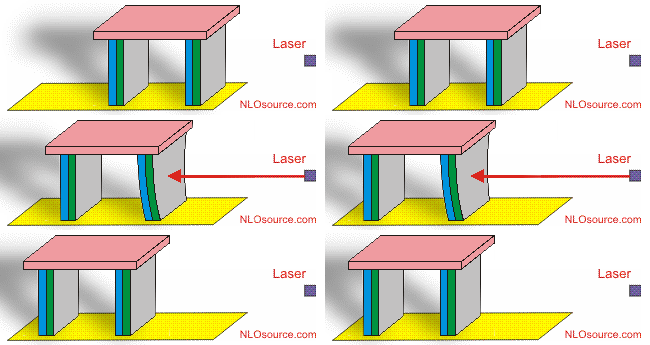
Two years ago, I felt glib satisfaction when NSF began soliciting "highly novel" proposals that showed potential for truly transformative breakthroughs. I was filled with certainty that the reviewers would see the brilliance of my ideas. The basis of my proposal was simple. In analogy to a transistor, which controls the flow of electrical current, the materials that we are studying can control the flow of light. They also act as sensors and can change shape in response to light. But the coup des gras is that these materials can be made into devices that can be integrated together into big morphing blobs with incredible intelligence (click here for a tutorial on photomechanical effects and smart materials).

We had built the an optical logic circuit - equivalent to several transistors worth of computing power, but with all the extra functionality, and all in a single device. We argued that in analogy to electronics, if we could demonstrate the equivalent of an integrated circuit (we started small, proposing to connect two such devices together), then the potential technological impacts would be staggering. Below is the summary of the three reviewers:

Summary Statement of Reviewer 1

The objective is to make a novel new material that has the ability to morph in response to stress or light. The PI aims to use this bifurcation component for mimicking a neural network. Although there are some concerns including size, scalability, speed and power efficiency, this might be a good test bed for studying unit components for a neural network.

Summary Statement of Reviewer 2

This is an excellent proposal with an interesting novel idea that can lead to a significant impact in a wide range of fields/applications. Also, the theoretical and experimental studies around this subject are broad enough to constitute a new field. I consider this proposal a highly transformative work.

Summary Statement of Reviewer 3

This is a visionary proposal with concrete short term goals. It could lay the foundation of a transformational shift in thinking about optical "materials." It is a refreshingly novel topic coupled with strong collaborations and interesting educational and outreach efforts. However, a more succinct background section combined with more extensive description of the experimental details would have made the proposal stronger.

Just based on the summaries, I would have thought that my proposal would be funded. There were no errors in my way of thinking, the worked seemed promising, and would even open up a new field.

To summarize the reviewer's comments (based on the full reviews and as alluded to in the summaries), the proposal was very good. The two criticisms were that (1) I did not provide extensive details of the experiments and (2) there were some concerns about how good this technology would be down the road. In essence, it would be akin to telling the inventors of the transistor that they had to anticipate all of the potential problems in building integrated circuits, and, that they did not give enough details about how they would design technologies that were decades away.

The National Science Foundation has an interest in supporting science to nurture new discoveries that are intrinsically interesting or that lead to new technologies - two criteria that my proposal met. Even my educational plan was considered innovative. However, to be fair, I understand that there are many more proposals submitted than can be funded, and not all good work can be supported. This is a fact of life that all scientists accept.

To end this post on a happier note, I quote the panel summary of a proposal of mine that was funded on the topic of theoretical studies of fundamental issues of light-matter interactions:

"This proposal addresses important and fundamental issue of optimizing nonlinear optical response of optical materials to achieve the highest figures of merit by performing modeling of 2nd, 3d and higher order non-linear susceptibilities. If successful, the theory/modeling will guide the materials synthesis in developing new optical materials with large nonlinearities increased by a factor of thirty, thus opening up interesting and important applications, e.g. in the area of cancer diagnostics and treatment. The panel members unanimously expressed support of this proposal as high payoff transformative direction of research."

Now this is a review that I don't mind reading repeatedly! But instead, my focus is on the steady progress that we are making over the last 2 years since the project was funded. In the end, a few declined proposals doesn't diminish the great satisfaction of doing interesting research.